
From Approved Plan to First Splash: How Your Austin-Area Pond Actually Gets Built
In our last blog, we walked through what happens when you first reach out and sit down with Ana and Eric to talk through your vision. Once the design is approved and the deposit is in, people usually ask the same question: what actually happens to my yard now?
Every pond we build in the Austin area moves through the same general stages, but not on the same clock. A small pondless water feature by the patio might wrap in a matter of days. A larger koi pond with streams, waterfalls, substantial stonework, and more complicated access will naturally take longer.
But the process isn’t just about digging, plumbing, rock and water. Every one of those steps is working toward something we’ve already talked about with you: how you want to experience your pond when it’s finished.
Here’s how we get there.
Before Ground Breaks: Design and Layout
Before any equipment shows up, we go back over the property with you and confirm everything settled on during the consultation.
This is about much more than finding the best viewing angle.
We want to know how you want to live with the water.
Maybe you want to walk right up to the deep end, where the koi learn to meet you at the edge. Maybe you want to sit with your feet in a shallow pooling section of the stream, completely immersed in the sound, movement, and negative ions of the waterfall. Or maybe your happy place is going to be a lawn chair under the porch fan, watching the fish frolic while dragonflies and butterflies flit around among the flowers.
Those are the things that determine where a water feature belongs.
Of course we think about what you’ll see from the kitchen window or patio. But we also think about where you’ll naturally walk up to the pond, where you’ll sit, where the sound of the waterfall will reach you, how close you can get to the fish, and how the pond will become part of the way you actually use your yard.
We aren’t looking for the easiest place to dig a hole. We’re looking for the place where the pond will be enjoyed the most.
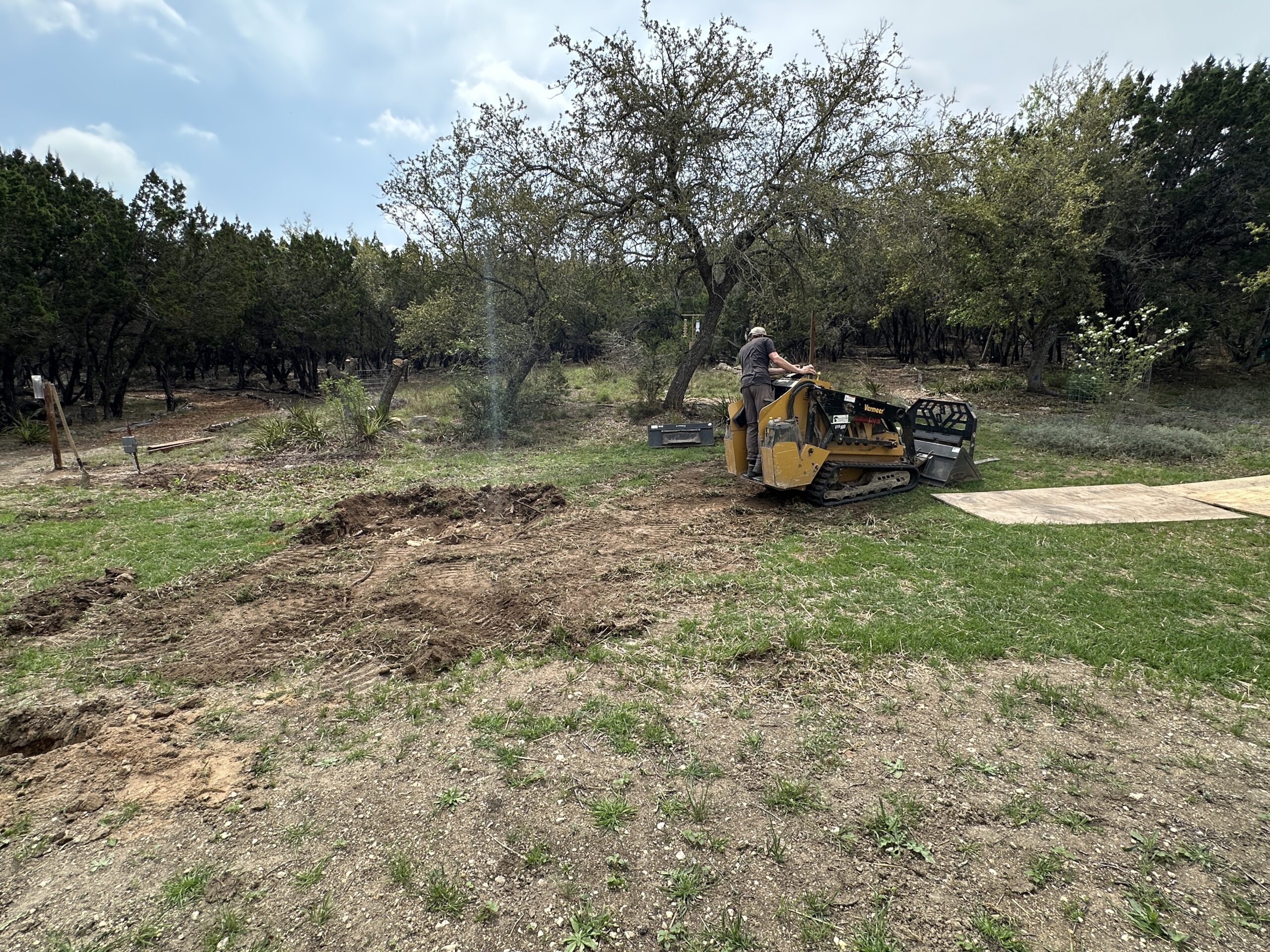
Excavation: Welcome to Hill Country Limestone
Then we start digging.
And in the Austin area, that very often means limestone.
A lot of Hill Country lots have only a relatively thin layer of soil before we hit rock. Sometimes it’s fractured and cooperative. Sometimes it’s impressively hard.
Either way, limestone isn’t a reason for us to move the pond or compromise the design just because another spot would be easier to excavate. We build ponds in Central Texas. We expect rock.
When the limestone gets hard, we bring in the equipment to handle it. That may mean hydraulic breakers, additional machinery, and sometimes quite a bit of patience. It’s simply part of the construction process here.
Depth gets planned with the local climate in mind, too. We like to go deep—not only in the pond itself, but in recirculation basins where appropriate—to take advantage of the earth’s more stable below-ground temperatures.
Think Barton Springs.
Getting recirculating water deeper below grade can help buffer it from the extremes happening at the surface during a Texas summer. And when August rolls around, cooler, well-oxygenated water makes everybody happier—fish, plants, beneficial bacteria, and the people sitting beside them.
Plumbing, Liner, and Mechanicals: The Part Nobody Sees Again

Once the excavation and shaping are complete, the underlayment and liner go in. They’re carefully placed with plenty of excess—not just as insurance, but to leave us room to keep working with the details. Streams and waterfalls develop as they’re built, and that extra liner gives us the freedom to fine-tune curves, pooling areas, edges, and transitions as the rockwork takes shape.
Next come the systems that keep all that water healthy and moving.
The biological filtration might be a constructed wetland filter for a natural swimming pond, or a smaller BioFalls tucked into the headwaters of a koi pond’s waterfall. Mechanical filtration might happen through an intake bay, a negative edge, or a skimmer, depending on the pond and how we’ve designed water to move through it.
Pumps are sized and placed, plumbing is run and hidden, and the entire system is built around keeping water circulating, oxygenated, and filtered appropriately for the size and purpose of the pond—and for Central Texas conditions.
And then we make it all disappear.
Filtration components are completely concealed within the landscape using natural rockwork, boulders, and gravel. Plumbing vanishes underground. Pumps are out of sight. By the time we’re finished, you shouldn’t be looking at equipment or wondering where the filtration is.
Nobody sits beside their pond admiring the plumbing.
You see stone, plants, moving water and fish. You hear the waterfall. Underneath and behind all of it is a carefully built system quietly doing the work that makes everything else possible.
Stone and Waterfall: Where the Hill Country Shows Up

This is the stage where a lined basin starts becoming something that looks like it belongs there.
Every boulder gets set, studied, and repositioned until it sits right. The rocks forming the waterfall are carefully fitted and sealed so we can control where and how the water moves—sometimes spilling in a clean sheet, sometimes tumbling and breaking over stone.
We lean heavily on native Hill Country stone because it blends naturally into the surrounding landscape and holds up beautifully in our climate. Then comes the slow work of dressing the edges so the liner disappears from every angle of sight.
And this is where those early conversations about how you want the pond to feel really start showing up.
Waterfall design isn’t just visual. The height of a drop, the rock the water lands on, the direction the falls face, and the volume of water moving through them all affect what you hear.
Maybe we want enough sound to reach your favorite chair on the porch. Maybe we want a quieter section where you can sit close to the fish. Maybe we’re building a shallow area where bare feet can be in the water while the waterfall fills the space around you.
We’re not just stacking rocks until water runs downhill. We’re building an experience.
Fill, Startup, and Planting
Then comes one of our favorite moments: water.
With the structure complete, the pond gets filled, the water is balanced, and the pump comes on for the first time. We make adjustments to the waterfall until the movement and sound of the water match what we designed.
Aquatic plants go in around this stage too, and in Austin they’re doing real work, not just decorating the edges. Shade-producing plants like water lilies help protect the water from intense Texas sun while also competing for nutrients that would otherwise help feed algae.
But they’re also part of what makes a finished pond feel alive.
The goal isn’t a sterile pool surrounded by rocks. It’s lilies opening across the surface. Grasses and marginal plants softening the shoreline. Flowers bringing in butterflies and dragonflies. Fish disappearing underneath a lily pad and coming back out to investigate whoever just walked up to the edge.
If koi are going in, we wait until the water conditions are ready for them rather than introducing them simply because everyone is excited to see fish in the new pond.

Living With Your Pond Once the Heat Sets In
A pond doesn’t arrive finished the way a piece of furniture does. It’s a small ecosystem, and it needs a little time to settle in.
Some cloudiness early on while the biological balance establishes is normal. Plants begin growing into their spaces, beneficial bacteria establish themselves, and the pond starts behaving less like something that was just constructed and more like an ecosystem.
Central Texas summers do require us to design and care for ponds with heat in mind. Good circulation and aeration become especially important as water temperatures rise, while aquatic plants provide shade and help create a more comfortable environment for fish.
And over time, something else happens: the pond becomes part of the rhythm of the yard.
You notice when the first lily blooms. The koi figure out exactly where feeding happens. Dragonflies patrol the shoreline. Birds discover the shallow water. You start hearing the waterfall through an open door without consciously listening for it.
That’s the part that’s hard to show on a construction plan.
For clients who don’t want pond care added to their own weekend list, ongoing maintenance can take care of the practical side. The goal isn’t just to make the pond beautiful on the day we finish it. It’s to keep the ecosystem healthy, balanced, and enjoyable for years afterward.
So How Long Does a Pond Actually Take to Build in the Austin Area?
There’s no single number, because no two water features—or yards—are exactly alike.
Size matters, of course. So do access, the complexity of the streams and waterfalls, the amount of stonework, equipment requirements, planting, and all the little details that turn a body of water into your pond.
And yes, limestone can add time. Sometimes breaking through Central Texas rock requires heavier equipment and more patience than digging through soil.
But the rock doesn’t get to decide where your pond belongs.
You do.
We choose the placement and design based on how you want to experience the water when we’re gone: feeding koi at the deep edge, putting your feet in the stream, listening to the waterfall from the porch, or simply looking out the window and realizing there are three dragonflies chasing each other over the lilies.
The excavation, plumbing, liner, stonework, planting, and all that limestone are just the process we use to get you there.
Curious what that process looks like for your property? Reach out and we’ll walk through it together.